

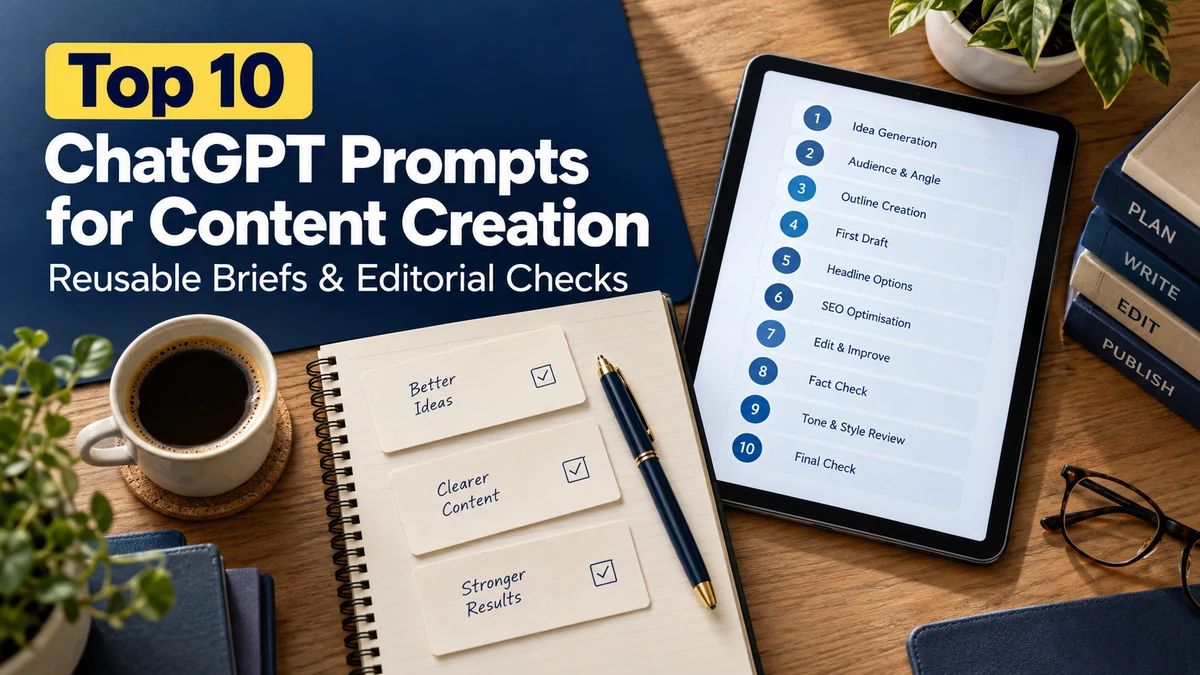
A useful prompt is a structured brief. It explains the task, audience, context, constraints and output format. The patterns below are starting points; replace placeholders with accurate information and review the result before publication.
Key Takeaways
- A useful prompt is a structured brief. It explains the task, audience, context, constraints and output format. The patterns below are starting po
- Use the prompt patterns as stages: clarify the audience, generate angles, build an outline, identify evidence gaps, draft from supplied notes, ed
- Never ask a model to invent sources, testimonials, statistics or quotations. Supply approved facts, mark claims that need verification and avoid
Ten adaptable prompt patterns for briefs, outlines, research, editing, repurposing and quality checks—designed to support original work rather than replace editorial judgement. The most useful decision is the one that fits the actual purpose, the evidence available and the experience expected by the person receiving the communication.
Ten practical prompt patterns
- Audience brief: “Help me define the audience for [offer]. Ask clarifying questions first; do not invent demographic or market statistics.”
- Content brief: “Create a one-page brief for [topic], including reader problem, search intent, key message, evidence needed and desired action.”
- Article outline: “Build an H1/H2/H3 outline for [topic]. Remove overlapping sections and explain what useful information each section must contain.”
- Draft from notes: “Turn these approved notes into a clear first draft for [audience]. Do not add facts, claims or quotations that are not in the notes.”
- Clarity edit: “Edit this paragraph for plain English and flow. Preserve the meaning, figures, names and qualifications; list any ambiguity instead of guessing.”
- Search-intent review: “Review this outline against the stated search intent. Suggest missing reader questions, but do not invent search-volume or ranking data.”
- Evidence-gap check: “Identify every factual, numerical, regulatory and comparative claim in this draft. Mark which claims need a source and why.”
- Social adaptation: “Adapt this approved article into three platform-specific post drafts. Keep each message useful and do not exaggerate the source material.”
- Email summary: “Create a concise email newsletter summary from this article with one clear takeaway and a truthful call to action.”
- Final editorial checklist: “Check this draft for factual accuracy risks, repetition, accessibility, tone, internal-link opportunities and unsupported promises. Return issues, not invented corrections.”
These are reusable structures, not guaranteed outputs. Replace bracketed fields with real context, supply approved facts and review the response before publishing.
What this guide covers
A useful prompt is a structured brief. It explains the task, audience, context, constraints and output format. The patterns below are starting points; replace placeholders with accurate information and review the result before publication. A clear scope prevents teams from confusing a record count, an API feature or a marketing label with proof that a campaign is suitable. Write down the intended outcome and the limits of the information before selecting a tool or provider.
Keep the business objective specific. Identify the owner of the process, the people affected, the information required and the action that should happen next. This makes it easier to explain the workflow to colleagues and to detect when a proposed use goes beyond the original purpose.
How to plan the right approach
Use the prompt patterns as stages: clarify the audience, generate angles, build an outline, identify evidence gaps, draft from supplied notes, edit for clarity, repurpose for channels and run a final accuracy check.
For a product article, provide the approved feature list and ask for a comparison outline, then request a list of claims that still need source confirmation before writing the final draft. Document the decisions that matter: who approved the activity, which source or system is involved, what information is used and how a person can ask a question or change their preference.
What to verify before choosing or launching
Never ask a model to invent sources, testimonials, statistics or quotations. Supply approved facts, mark claims that need verification and avoid including confidential or personal data.
- Confirm ownership and the person responsible for approving the work.
- Check the source, permissions, technical requirements and current terms that apply.
- Test the complete journey, including failure, correction and escalation paths.
- Keep a record of decisions, changes, incidents and customer preferences.
Responsible use, accuracy and human review
Do not publish the first output unchanged or reuse the same generic prompt for unrelated audiences.
Use approved information, protect confidential material and verify outputs before they are shared or used to make decisions. Keep a human accountable for customer-facing, financial, legal, employment or other consequential work. AI assistance should make a process clearer—not hide uncertainty or remove necessary judgement.
Measure outcomes and improve
Evaluate prompts by revision effort, factual accuracy, audience fit, originality and consistency across repeated tasks.
Set a baseline before launch and review results over a defined period. Compare like with like, segment the data where appropriate and investigate unexpected changes before drawing conclusions. A metric should help the team make a better decision, not simply make a report look impressive.
Common mistakes to avoid
Do not publish the first output unchanged or reuse the same generic prompt for unrelated audiences. Another frequent mistake is measuring activity without checking whether it produced a useful result. Review the customer experience, operational workload and any negative feedback alongside the headline metric.
Keep the process documented and revisit it when the product, provider, rules or audience changes. If an important fact cannot be verified, label it as unconfirmed and resolve it before publication or campaign launch.
Frequently Asked Questions
What should I check first?
Start with the purpose, source, permissions, scope and evidence. Then test the complete workflow before scaling.
Does a large record or message count guarantee results?
No. Volume does not guarantee relevance, delivery, response or conversion. Measure the outcome that matters to the business.
Can I use the same process for every audience?
Usually not. Requirements vary by audience, channel, geography and purpose. Segment carefully and review the applicable rules.
How often should this process be reviewed?
Review it whenever the provider, platform, law, data source or campaign purpose changes, and on a regular schedule set by the business.
Explore related Astral Promotion services
Explore the related service Explore the related service
Conclusion
Ten adaptable prompt patterns for briefs, outlines, research, editing, repurposing and quality checks—designed to support original work rather than replace editorial judgement. Use a documented, evidence-led approach, protect the people affected by the workflow and review the results before expanding it. For a service discussion, visit the relevant Astral Promotion service page or contact the team with your requirements.



Comments and discussion
Be the first to join the discussion. Comments are reviewed before appearing publicly.