

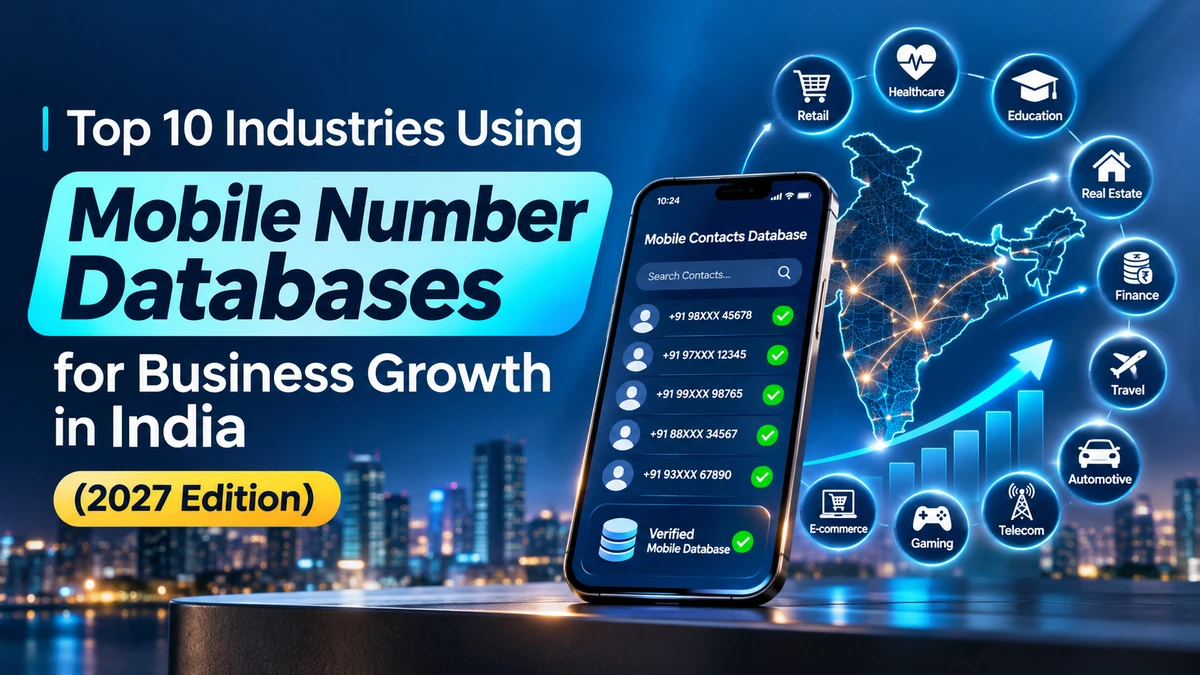
Mobile numbers can help a business connect a real-world customer journey with a timely digital interaction. Used carefully, a well-defined and lawfully sourced contact dataset can support market research, customer service planning, event communication and permission-based outreach. The important question is not simply how many records a file contains. It is whether the business has a clear purpose, reliable provenance, appropriate permission and a useful follow-up plan.
Key Takeaways
- A database is only useful when its source, purpose, permission and fields are clear.
- Ten industries can use structured contact information for distinct business workflows.
- Verification of a number does not automatically establish permission to market to a person.
This 2027 guide looks at ten industries in India where structured mobile-contact data may support business growth. It also explains how to evaluate a provider, avoid wasteful campaigns and keep communication aligned with applicable rules.
What a mobile number database should mean
A business database is a structured set of records assembled for a defined and permitted business purpose. Depending on the product and the source, a record may contain a business name, contact role, city, industry, public business contact channel or other fields. A phone number is personal data when it relates to an identifiable individual, so businesses should not assume that possession of a number automatically gives them a right to contact that person.
Before using any dataset, ask how it was collected, what notice and permission apply, what uses are allowed, when it was last reviewed, how corrections and opt-outs are handled, and what evidence can be supplied. A provider should be able to explain the scope rather than relying on vague labels such as “verified” or “updated”.
Ten industries that use structured contact data
1. Retail and e-commerce
Retailers can use customer-authorised contact records to manage loyalty updates, order-related communication, product availability alerts and local store events. Segmentation by prior relationship, product interest and preferred communication channel is more useful than sending the same offer to every record. For promotional outreach, permission and opt-out status should be checked before a campaign is prepared.
2. Healthcare and wellness
Clinics, diagnostic centres and wellness providers may need contact workflows for appointment confirmations, preparation instructions, follow-up reminders and service information. Health-related communications require particular care: avoid exposing sensitive details in an ordinary message, confirm the recipient and purpose, and restrict access to patient data. Marketing should never be mixed casually with essential care communication.
3. Education and training
Schools, coaching centres and professional training providers may communicate course schedules, admission milestones, open-house invitations and updates with people who have asked to hear from them. Separate enquiries from enrolled learners, keep course-interest information current and make it easy for recipients to stop promotional messages.
4. Real estate
Property businesses may organise enquiries by location, property type, budget range and stage of interest. The most useful workflow is usually a small, relevant follow-up based on an actual enquiry or permission—not a mass message to an unrelated list. Do not infer a person's income, financial status or willingness to buy from a phone number alone.
5. Automotive and dealerships
Dealerships, service centres and automotive businesses can use customer-authorised records for service reminders, test-drive follow-ups, vehicle availability and event invitations. Service records should be kept distinct from promotional lists, and the business should record the purpose and channel preference associated with each contact.
6. Hospitality, travel and events
Hotels, restaurants, travel operators and event organisers can use permission-based contact information for booking updates, itinerary information, event registration and relevant seasonal offers. Location and language preferences can improve relevance, but the recipient should still understand which business is communicating and why.
7. Banking, insurance and financial services
Financial organisations have strict obligations around customer information, security and communication. Approved contact details may support account servicing, policy updates or customer-requested information. Do not treat a purchased or third-party list as a shortcut to financial solicitation. The organisation's compliance team should approve the lawful basis, permitted purpose, content and channel before any outreach.
8. Logistics and delivery
Logistics businesses need accurate contact routes for pickup coordination, delivery notifications and service exceptions. These operational messages should be limited to the transaction or service context. Keep proof of the underlying order or relationship and avoid turning operational contact information into an unrelated marketing database.
9. Professional and B2B services
Consultancies, IT firms, agencies and service providers can use verified business contact information to map accounts, identify relevant organisations and organise relationship management. A business switchboard or role-based contact is not the same thing as consent to send repeated promotional messages to an individual. Choose the least intrusive contact method that fits the purpose.
10. Manufacturing and distribution
Manufacturers, wholesalers and distributors may organise authorised dealer, supplier, service-partner and buyer records by region, product category and account relationship. Clean records can support service bulletins, catalogue requests and channel-partner communication. Clearly label whether a record represents a company, a role or a named person.
How to evaluate a provider before purchase
- Provenance: Ask for a written explanation of the source, collection method and the provider's authority to supply the records.
- Purpose and permission: Confirm the documented purposes, notices, permissions and any restrictions that apply to the intended use.
- Coverage: Define the states, cities, industries, business types and record fields included. Do not rely on a broad “Pan India” label without a coverage schedule.
- Freshness and verification: Ask what “verified” means, how checks are performed, what date the checks were completed and what limitations remain.
- Suppression and correction: Confirm how opt-outs, corrections, complaints and duplicate records are handled.
- Security: Review transfer method, access control, retention period and deletion process.
Plan the campaign around the permission
Start by writing down the business outcome: a requested callback, an appointment reminder, a service update or a specific promotional offer. Match the channel to the recipient's expectation. Keep the audience narrow, use a recognisable sender identity, make the message useful, provide an appropriate way to opt out and record the result. Review complaints and opt-outs as seriously as clicks or conversions.
For bulk SMS in India, the sender also needs to follow the applicable Telecom Commercial Communications Customer Preference Regulations (TCCCPR) requirements, including the relevant Principal Entity, header, content-template and consent processes. A database file does not replace the sender's own telecom compliance obligations.
Frequently asked questions
Does owning a mobile number database mean I can send promotional messages?
No. The right to hold or receive a dataset and the right to contact each person for a particular purpose are separate questions. Check the permission, notice, applicable law, channel policy and opt-out status before contacting anyone.
Is a “verified” label enough?
No. Ask the provider to define the verification method, date, fields checked and limitations. Verification of a number's format or reachability does not prove consent or marketing permission.
Which industry gets the best results?
There is no universal winner. Results depend on the audience, offer, relationship, channel, timing, service quality and measurement method. A smaller, relevant and properly permissioned audience is often more useful than a larger, poorly defined file.
Final checklist
Use mobile-contact data as a carefully governed business input—not as a shortcut around customer trust. Define your purpose, check the source and permissions, choose relevant segments, protect the records, follow the rules for the selected channel and measure meaningful outcomes. For tailored database coverage, ask Astral Promotion to confirm the current product scope, field definitions and supporting documentation before placing an order.
Official guidance
TRAI: Advice to Senders · MeitY: Digital Personal Data Protection framework.
Comments and discussion
Be the first to join the discussion. Comments are reviewed before appearing publicly.